

Silicone rubber molding for electrical insulation parts requires more than stable clamping and accurate mold temperature. Feed consistency and injection control now have a stronger influence on product quality, especially when manufacturers work with long components, complex cavities, or demanding insulation requirements.
A well-managed silicone rubber injection molding machine helps processors keep material movement more predictable from feeding to cavity filling. In insulator production, this can reduce variation between cycles and support better control over dimensions, surface quality, and material distribution.
Why Feed Stability Matters in Insulator Production
Silicone rubber can behave differently from many conventional thermoplastics. Its flow response depends on formulation, temperature, feeding condition, and the pressure applied during injection. Irregular feeding can therefore create unstable shot volumes, which may affect the final shape of molded insulation products.
For hollow core insulators, long rod insulators, and surge arresters, material must travel through relatively long flow paths. Feed inconsistency may result in short filling, uneven packing, or unnecessary flash. These defects can raise trimming work and increase the risk of rejected parts.
Stable feeding also matters when a production line changes between silicone rubber and EPDM. Each material has different processing behavior. The machine setup, screw or injection parameters, and temperature settings need to match the selected compound instead of relying on one fixed operating condition.
This is why many manufacturers now evaluate feeding systems together with injection control. A silicone rubber injection process is easier to manage when material supply, metering, pressure, and speed are treated as connected steps rather than separate functions.
Injection Control Affects More Than Filling Speed
Injection speed is only one part of process control. Pressure buildup, metering accuracy, holding behavior, and shot repeatability can all affect the molded part. For electrical insulation products, small process changes may influence dimensions, surface appearance, and the distribution of material around metal inserts.
Long rod insulators and cable accessories can be sensitive to uneven filling. If the material front moves too quickly, air may become trapped in the cavity. If it moves too slowly, the compound may not fill narrow or distant areas as expected.
For this reason, processors often tune injection in stages. Initial filling may use one speed, while later filling can be reduced to control pressure near the end of the stroke. This staged approach gives operators more room to balance cavity filling with flash control.
A well-configured silicone rubber injection molding machine can support this type of parameter adjustment, but the machine still needs to be matched with mold design, compound behavior, and the dimensions of the target insulator.
Equipment Selection Should Follow the Product
Machine selection should start with the actual molded component. Clamp force, shot size, mold dimensions, material type, and required cycle conditions all need to be reviewed together. Large insulators may require very different settings from smaller cable accessories or switchgear parts.
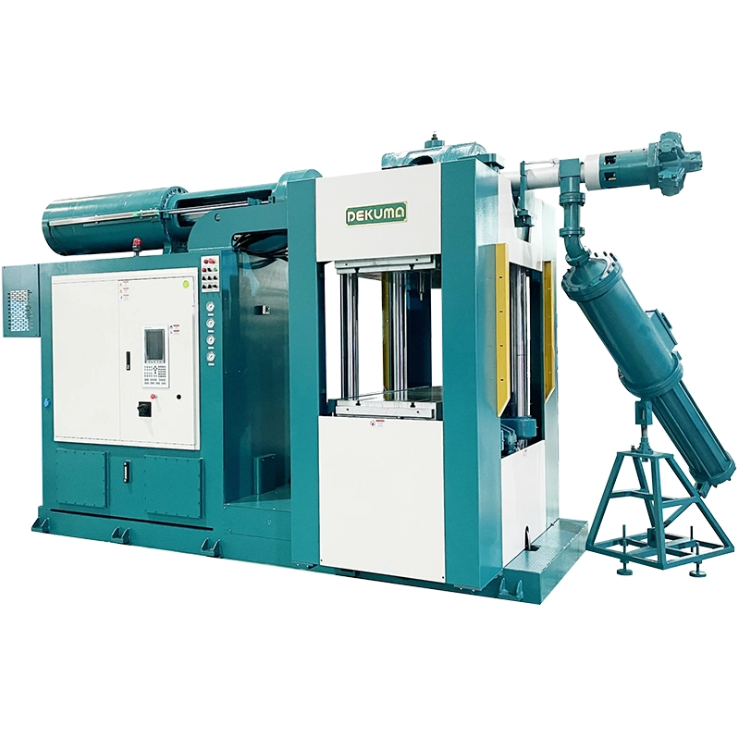
This is also where supplier experience becomes useful. Dekuma offers the RA Series Rubber Injection Molding Machine for applications such as hollow core insulators, long rod insulators, surge arresters, cable accessories, and switchgear. The series is compatible with silicone rubber and EPDM, giving processors options for different insulation product programs.
The RA Series is presented for stable operation and consistent insulator production. Its application background is also supported by industry experience, patents, and certifications. For B2B buyers, these points are more meaningful when reviewed together with mold requirements, production targets, and factory process conditions.
Rather than choosing equipment by machine size alone, buyers can compare how well the injection unit, control system, and material handling approach fit the intended part. This makes technical discussions more focused and can reduce unnecessary changes after installation.
Process Monitoring Becomes More Important at Scale
When production volume rises, small variations can become expensive. A minor change in shot weight or injection pressure may not be obvious in a few samples, but it can create a larger quality problem over long production runs.
Manufacturers can therefore track key process data such as injection pressure, filling time, material temperature, and shot consistency. These records help teams identify whether a defect comes from material changes, machine settings, mold condition, or operator adjustment.
The same approach is useful during new mold trials. A controlled silicone rubber injection setup makes it easier to compare parameter changes and document which combination produces acceptable parts. This is especially useful for factories that manage several insulator sizes or materials.
Dekuma can be considered in this context as an equipment supplier with experience in rubber injection molding and turnkey project support. They can fit into projects where buyers need equipment that matches specific insulation products rather than a general-purpose molding process.
Feed and Injection Control Will Remain a Practical Focus
Manufacturers can evaluate feed and injection control by tracking shot consistency, filling defects, and process variation across production runs. Better control at these stages gives process teams clearer ways to adjust molding conditions and respond to defects.
For B2B manufacturers, the value of a silicone rubber injection molding machine depends on how well it supports the actual production process. Stable feeding, controlled injection, suitable mold matching, and practical monitoring all contribute to a more manageable silicone rubber injection operation without adding unnecessary complexity.
